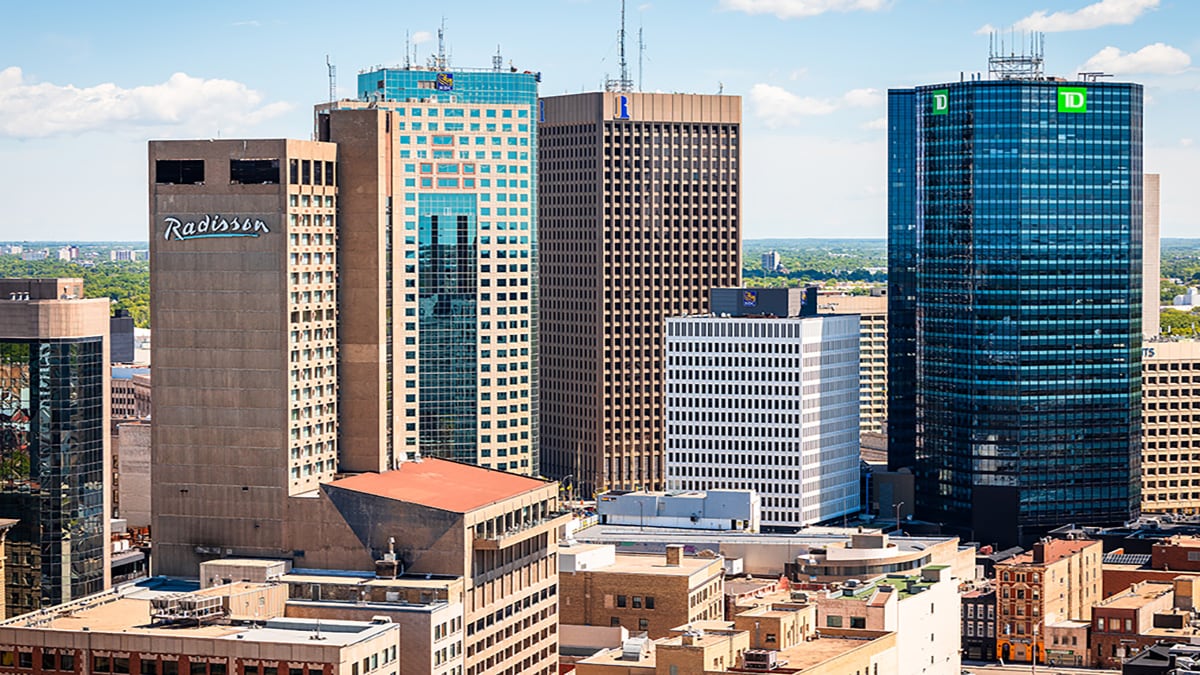
Last December, The Globe and Mail published its annual ranking of Canada’s most livable cities. Each city is scored across 10 categories, with unique weights assigned on how important those factors are to residents. Housing and health care carry the most weight, as they are key considerations when people decide where to live. Winnipeg ranked fourth out of 448 cities, slipping one spot from third place the year before. Not far behind are Regina, Saskatoon, and Calgary, in fifth, sixth and seventh place, respectively. These cities are Winnipeg’s closest competitors (friendly, of course) for business, tourism, events, and people on the prairies— hence the title.
House prices and income
The Canadian Real Estate Association (CREA) has a House Price Index (HPI) data portal that tracks benchmark prices for all home types in major Canadian cities. The chart (figure 1) shows benchmark prices for Calgary, Regina, Saskatoon, Winnipeg, Ottawa, and Halifax.

Figure 1
Before 2016, these cities could be categorized as affordable or highly affordable, with Calgary possibly standing out as only marginally affordable. But that changed after the onset of the COVID-19 pandemic.
Housing prices in Calgary, Ottawa and Halifax have increased dramatically. Halifax, in particular, saw its benchmark price rise from just over $300,000 in 2019 to nearly $540,000 in 2024— an 80 per cent increase in five years. By comparison, Winnipeg and Saskatoon saw price increases of nearly 30 per cent and Regina had the most modest rise at 14 per cent over the same period.
Focusing on the prairies, we can compare the ratio of house prices to median employment income (annual data from Statistics Canada), the story is a little different (a low ratio is better than a high one). Before the pandemic, Calgary’s higher salaries helped offset its elevated home prices, keeping its ratio only slightly above those of Winnipeg, Regina, and Saskatoon. This balance helped Calgary maintain its status as a relatively affordable major city with strong amenities.

Figure 2
The gap between Calgary and Winnipeg’s house price and median income ratios has tripled since 2019 (meaning Calgary is becoming less affordable than Winnipeg). But Winnipeg is not in the clear—especially when compared to Regina and Saskatoon. From 2010 – 2018, Winnipeg’s ratio was lower than both Regina’s and Saskatoon’s. In 2019, it nudged above Regina’s and has remained there, with the gap widening from 2021 and beyond. On top of that, Winnipeg is now edging closer and closer to Saskatoon’s ratio.
According to March 2025 data from wowa.ca, the average house price in Winnipeg is now $402 915 compared to $399,742 in Saskatoon. If median employment income in Winnipeg does not rise faster than in Saskatoon, Winnipeg could surpass Saskatoon in unaffordability—for the first time in at least 15 years.
Preventative action, not curative
The worst-case scenario for Winnipeg is a housing price surge like those seen in Halifax and Ottawa. A close second is the Calgary scenario, a slower but still damaging affordability decline. Even the best of the worst outcomes would see Winnipeg pulling away from Regina and Saskatoon in home prices while incomes stagnate. That could knock Winnipeg out of Canada’s top 10 most livable cities. But there are signs of progress. Governments at all levels are working on affordability measures that could help keep Winnipeg’s housing costs under control—or even bring its price-to-income ratio back to its pre-pandemic position and below that of Regina’s and Saskatoon’s.
The federal government plans to increase the supply of modular housing (houses with large sections built offsite in a factory and then transported and assembled on location) and speed up approvals using pre-approved blueprints. This is meant to kick-start production, lower construction costs and reduce delays by eliminating permit backlogs for pre-approved designs. The Manitoba government’s Budget 2025 earmarks funds to build 525 Rent-Geared-to-Income (RGI) social housing units and expands access to temporary winter shelters. These measures aim to support people experiencing homelessness and those who are already struggling to afford rent.
Finally, the City of Winnipeg, like many other municipalities in Canada, is working towards converting vacant properties into housing units, both downtown and in other locations, such as Pembina Highway, South Osborne and William Avenue. All of the above will help to increase the supply of housing, which at the very least, will keep prices stable if not deflate them at a healthy pace. Hopefully, the sky will not fall upon Winnipeg’s affordability advantage, and we will retain our position as one of Canada’s most livable cities.
