
The building blocks of trade barriers
To better understand the interprovincial trade barriers in Canada, we can go back to 1867 when the British North America Act (BNA), also known as the Constitution Act, was signed by the provinces of Canada (Ontario and Quebec were then one province), New Brunswick and Nova Scotia. [1] The two maritime provinces were much richer than the inland region of Canada and thus required political compensation if they were to join into a formal union with the latter. The provincial governments were guaranteed equivalent status with the federal government, but with separate responsibilities and jurisdictions.

Fathers of Confederation [canadahistory.com]
To date, provinces have authority over local affairs, which spans civil rights, labour and product standards, and other regulatory oversights. The federal government, however, does have the right to block or override provincial legislation that interferes with internal trade. And therein lies the root-cause of Canada’s interprovincial trade barriers: the provinces have the right to set their own rules over commerce, labour and other areas of the economy; while the federal government has the right, if not a mandate, to ensure goods, services and labour can flow freely throughout the Dominion of Canada.
This conflict has gone before the Supreme Court of Canada on several instances and each time the court has ruled in favour of the provincial government(s). [2] In their decision, the Supreme Court stated that the Constitution should be interpreted with provincial diversity in mind and their (the provinces) right to regulate local affairs. Agree with the Supreme Court’s decision or not, the implications thereof for interprovincial trade in Canada are unambiguously negative. In fact, Alvarez, Krznar, and Tombe (2019) estimated that completely liberalizing interprovincial trade could increase GDP per capita by as much as 4%. [3]
Trade barriers in detail
These trade barriers come in a variety of forms, with arguably the largest being geography. For a little perspective, it takes roughly 30 more minutes to fly from St. John’s Newfoundland to Dublin, Ireland, than it does to Winnipeg. Looking westward, it takes approximately 13 hours to drive from Winnipeg to Calgary, and over 10 hours to drive from Calgary to Vancouver, even though the direct flight distance between Calgary and Vancouver is slightly more than half of the direct flight distance between Calgary and Winnipeg. Unless a new method of travel is achieved, these geographic barriers will remain intact (Figure 2 A, and B).
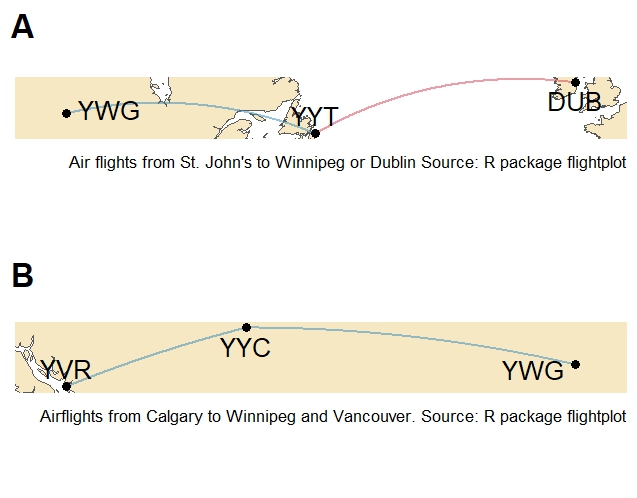
Figure 2: Flight distances A: St. John’s to Winnipeg vs Dublin, B: Calgary to Vancouver vs Winnipeg
Another natural barrier to trade is language. Quebec is Canada’s only official Francophone province, while New Brunswick is Canada’s only official bilingual province. Each of these provinces will have certain French language requirements, as is their right, and like the geographic barriers, they are not going anywhere. It should be noted that Francophone businesses and people face an equivalent English barrier if they want to expand into an Anglophone province.
The remaining trade barriers, which can be removed or minimized, are classified as regulatory, administrative, technical, or prohibitive:
- Regulatory barriers are created by different professional or product requirements across provinces. For example, Manitoba required nurses trained out of the country to work 450 hours in Canada over the past two years before they could be registered to work in Manitoba. This process is being expedited to shorten the amount of time it takes to register a new nurse in Manitoba if they have already been registered elsewhere in Canada.
- Administrative barriers require some businesses to set up local establishments to carry out activity and/or receive permits. Several provinces and municipalities require firms to have a local business license(s) to bid on government contracts.
- Technical requirements refer to standards specific to particular industries, such as trucking weight restrictions and dimensions.
- Prohibitive barriers are due to provinces not allowing certain business activities. The best example of this is not allowing for the direct (producer to wholesaler) purchase of alcohol across provincial borders.
The argument in favour of removing these barriers is to decrease the monetary and time costs associated with moving goods, services and labour between provinces and territories. These costs come in the direct form of complying with different technical requirements, such as altering vehicle specifications; the administrative costs of setting up an out-of-province office when the services could be provided remotely; the amount of time it takes for labourers to be recertified; the additional fees charged when goods, such as alcohol, are sold across borders; and other hurdles that businesses and workers encounter.
Taken together, these barriers do not just increase the costs associated with trading but also decrease the volume of trade and the amount of labour mobility because companies and/or people find compliance to be too burdensome and decide not to do business/move out of province. Some local businesses have gone as far to say that it is easier to do business in the U.S. than in other provinces. The businesses and labourers not directly affected by the trade barriers are still impacted, indirectly, by the negative spill-over effects of the barriers on the rest of the economy (lower GDP and fewer jobs).
Deconstructing the trade barriers
Canada and Provincial/Territorial Governments made significant progress in addressing internal trade by adopting the Canadian Free Trade Agreement (CFTA) in 2017 in parallel to adopting the CETA Free Trade Agreement with the European Union (GAC, 2017). [4] The approach taken up until 2025 has been primarily one of harmonization, which takes considerable time. The slow progress on internal trade barriers encouraged regional approaches, such as the New West Partnership to spring up. [5]
The US’s threatened and actual trade actions have strongly encouraged the Canadian, Provincial and Territorial governments to move quickly to remove internal trade barriers. Rule harmonization, though an option, is viewed as too slow for the moment.
A recent article by (Ferris, 2025) noted that certain internal trade barriers, in the form of exceptions (also called existing measures, which are from 2020 and earlier; or future measures, which are new or will be maintained into the future) outlined in the CFTA, still remain at the national, and provincial/territorial level. Ontario recently removed all its exceptions (Internal Trade Secretariat, 2025). As of July 2, 2025, Manitoba still had eight exceptions (five existing and three future measures), while the Canadian federal government has dropped from seven to zero due to the passage of Bill C-5 (See Figure 3).
 Figure 3: Canada, Count of CFTA exceptions
Mutual recognition is an approach suggested by (Manucha & Tombe, 2022) that will effectively remove internal trade barriers and is the preferred, more expedient, alternative to harmonization. [6] Their paper finds that the Canadian economy could increase by somewhere between $100 and $200 billion per year if internal trade barriers are eliminated by mutual recognition policies. In a different article for the Macdonald – Laurier Institute (Tombe, March 2025), it has been estimated that Manitoba’s GDP would increase by 4.2% if the costs of internal trade barriers was reduced by 10% unilaterally in Canada (See Figure 4 below). [7]

Figure 4: GDP gains from 10% unilateral reduction in internal import costs
Provincial and territorial governments have been signing memorandums of understanding to mutually recognize their rules in select cases. Manitoba has signed agreements with Ontario (May 14, 2025) and British Columbia (June 6, 2025) already. More are to come: Nova Scotia, Ontario, Alberta, British Columbia, Manitoba and Prince Edward Island have all taken steps to improve interprovincial trade, with Ontario being the most active.
The current push to remove internal trade barriers in Canada is resulting in legislation. For example, Ontario’s internal trade bill (Bill 2, 2025) received Royal Assent on June 5, 2025. Similarly, the Manitoba government recently passed (Bill 47, 2025). Schedule A in the legislation cites what the legislation does not apply to:
“a) “the provision of goods or services by a corporation or other body referred to in or under section 2 of The Crown Corporations Governance and Accountability Act;
b) a profession to which The Fair Registration Practices in Regulated Professions Act applies;
c) an occupation to which The Labour Mobility Act applies;
d) an entity, good or service or other profession or occupation exempted by regulation.”
The Canadian government introduced legislation (C-5, 2025) on June 6, 2025. Bill C-5 received Royal Assent on June 26, 2025. Part 1 is about mutual recognition, while part 2 is about building Canada. [8] It is expected that further mutual recognition activities will occur in 2025 and into 2026 to remove barriers to trade inside Canada.
During the public C-5 debate, various Indigenous (First Nations), Inuit and Metis organizations expressed concerns over the legislation because it will exempt select projects that have been chosen by the federal cabinet from various legal requirements. This could infringe upon the consultation rights of local Indigenous groups that will be directly affected by said projects. The Supreme Court of Canada has upheld Indigenous groups right to be consulted, in accordance with the United Nations Declaration on the Rights of Indigenous Peoples. [9] However, this does not grant Indigenous group veto rights over projects, but it does entitle them to a rigorous consultation process.
In July, nine First Nations communities in Ontario launched a constitutional challenge against the federal government over Bill C – 5 and later that week, during a summit between the Prime Minister and First Nations groups, several attendees walked out within a few hours of it starting and there were youth demonstrations outside the venue. [10] Hopefully, the continued efforts towards reconciliation will bring about an understanding between the parties involved without forcing a solution that lacks consensus.
More locally, the Hudson Bay Railway (HBR) and the Port of Churchill will be near the top of Manitoba’s project wish list. The HBR is owned by the Arctic Gateway Group which is a “proudly Indigenous and community owned Manitoba company” who will certainly follow due process to ensure they are consulting with locals on the potential impacts of the investments in the Port of Churchill and HBR. This should make for a very smooth approval process and decrease the amount of time it takes for the upgrades to complete. In the meantime, the Arctic Gateway Group has announced that they are doubling the number of weekly freight rail trains and tripling their storage capacity of critical minerals. [11] This is a strong signal that the Port of Churchill is open for business and, more importantly, investment.
The Manitoba provincial government is working with Indigenous groups on an Indigenous Crown entity to review and approve economic projects, as noted in the Winnipeg Free Press. [12]
The road forward
It may be surprising to learn that Manitoba is a province which trades more with other provinces/territories than it trades with other countries (Figure 5). [13] Hence why so many people support the claim that easing trade barriers with other provinces and territories will increase Manitoba’s GDP.
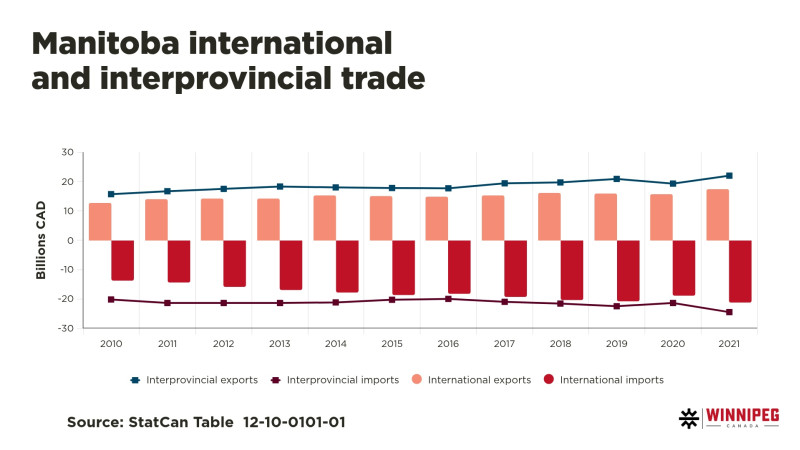
Figure 5: Manitoba international and interprovincial trade (Ferris Feb 27 2025)
Finally, the investment in HBR and Port of Churchill to boost trade capacity has the potential to expand shipping from Manitoba and other Western provinces for a variety of goods and materials (agriculture, mining and other sectors). This would drastically reduce the logistical costs faced by the Western provinces (particularly from Alberta, Saskatchewan and Manitoba) when they trade with markets in Europe and other Atlantic regions. In addition, the expansion would boost activity with the Kivalliq Region of Nunavut. In the not-so-distant future, when more trade barriers have been removed and the other proposed major economic projects are completed along with the Port of Churchill and HBR enhancements, the global economy will be Manitoba’s oyster.
References
[1] BNA Act, link https://www.justice.gc.ca/eng/rp-pr/csj-sjc/constitution/lawreg-loireg/p1t11.html.
[2] See Gold Seal v Alberta [1921] 62 SCR 424 noted in: https://www.yorku.ca/osgoode/thecourt/2017/10/17/tempering-r-v-comeau-a-primer-on-the-international-trade-debate-part-2/#:~:text=In%20particular%2C%20the%20decision%20in,(Comeau%2C%20para%20125).
[3] Alvarez, Krznar, and Tombe (2019). “Internal Trade in Canada: Case for Liberalization,” IMF WP 10/158, link https://www.imf.org/en/Publications/WP/Issues/2019/07/22/Internal-Trade-in-Canada-Case-for-Liberalization-47100.
[4] Source: Canadian Free Trade Agreement, link https://www.cfta-alec.ca/
[5] See NWP (2025 June 30). New West Partnership: http://www.newwestpartnershiptrade.ca/.
[6] See Manucha, R., & Tombe, T. (2022, September 20). Liberalizing internal trade through mutual recognition: A legal and economic analysis. Retrieved from Macdonald Laurier Institute: https://macdonaldlaurier.ca/liberalizing-internal-trade-through-mutual-recognition-a-legal-and-economic-analysis/
[7] Tombe, T. (March 2025). “Nova Scotia’s big trade reform could shake up the country—for the better: Trevor Tombe in The Hub,“ Retrieved from Macdonald Laurier Institute: https://macdonaldlaurier.ca/nova-scotias-big-trade-reform-could-shake-up-the-country-for-the-better-trevor-tombe-in-the-hub/.
[8] C-5. (2025, June 30). An Act to enact the Free Trade and Labour Mobility in Canada Act and the Building Canada Act. 1st Session, 45th Parliament. Canada. Retrieved from https://www.parl.ca/DocumentViewer/en/45-1/bill/C-5/royal-assent.
[9] United Nations Declaration on the Rights of Indigenous People, (2007, September 13th) https://www.un.org/development/desa/indigenouspeoples/wp-content/uploads/sites/19/2018/11/UNDRIP_E_web.pdf.
[10] Article by The Guardian (2025, July 19)
[11] Winnipeg Free Press Article (2025, July 15), link:
[12] Maggie Macintosh (August 8, 2025) “Kinew pitching Indigenous Crown entity to review, approve economic projects,” link:
[13] See pages 8 and 9 of Ferris, C. (2025, Feb 27). Manitoba Trade Outlook. Retrieved from LinkedIn:
