
Introduction
To say that 2025 was tumultuous for Canadians would be an understatement. Our relationship with the U.S. was turned completely upside down and may not fully recover for years. Domestically, the political response has been mostly uniform across the country (“elbows up”). However, depending on the nature of the tariffs (U.S. or Chinese), the economic impacts have varied across provinces and industries.
In the midst of these political and economic disturbances, a new federal government was elected and has brought its own vision for Canada going forward. This Digest will unpack the major political and economic events of 2025. We will work our way from the federal level all the way to the municipal (Winnipeg) level, then string it all together before concluding with a discussion of what lies ahead for 2026.
Canada
 After winning the 2024 U.S. presidential election, Donald Trump promised sweeping tariffs on all imports into the U.S. What followed was a flurry of uncertainty: tariffs were implemented through executive orders, deadlines were set and then postponed, diplomats scrambled, the steel and aluminum sector was targeted (again), the Canadian and Mexican governments worked to tighten their borders, and U.S. businesses lobbied against the tariffs. Despite these efforts, the U.S. government’s desire to bring manufacturing back to the U.S. proved too strong. Thankfully, goods and services within the Canada-United States-Mexico Agreement (CUSMA) were exempt and the tariffs on energy were limited to 10 per cent. The steel, aluminum and automotive manufacturing sectors, however, were not so lucky.
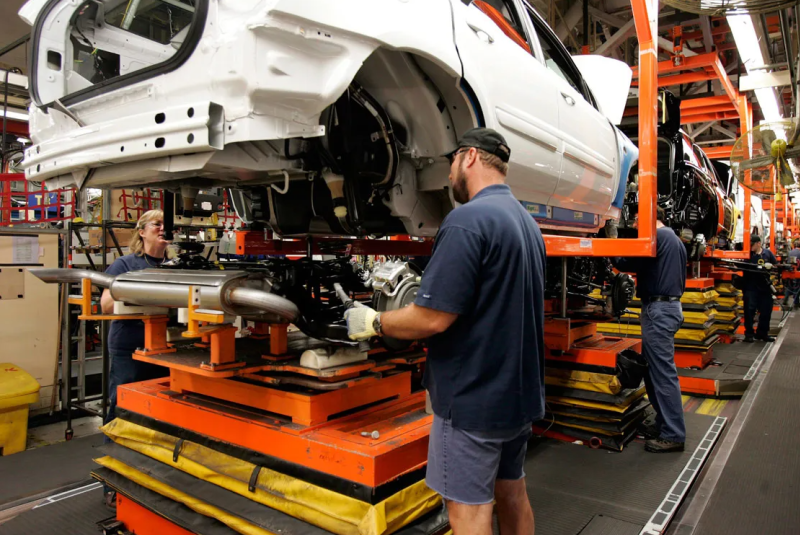 Canada retaliated against the U.S. tariffs with a set of reciprocal tariffs on U.S. steel, aluminum and auto parts, as well as other goods that were selected to maximize damage, such as Florida orange juice and Kentucky bourbon. Some of these counter tariffs were later rescinded in the summer. Households expressed their discontent by boycotting U.S. goods and altering their travel plans to avoid the U.S. In March 2025, tariffs on Canadian steel and aluminum were doubled from 25 per cent to 50 per cent, rendering the U.S. market inaccessible to Canadian producers. As a direct result of the 50 per cent tariff, Algoma Steel laid off 1,000 employees. To put that number into perspective, there are almost 77,000 people living in the Sault Ste. Marie census metro area, where the Algoma Steel plant is situated, meaning 1.3 per cent of the population lost their jobs (equal to 3.2 per cent of the workforce). Canadian auto manufacturers also struggled as demand for their parts and vehicles declined and some production shifted to the U.S. As of January 2026, more than 1,200 automotive workers — mostly in Ontario, and to a lesser extent Quebec — have been laid off.
U.S. tariffs on Canadian lumber increased from 14.5 per cent to 35 per cent then to 45 per cent in 2025, predominantly impacting B.C. and New Brunswick (N.B.). In B.C., several log mills announced plans to close their operations, which will result in hundreds of lost jobs. An American company, Woodland Pulp LLC, stopped importing wood from N.B. after the additional 10 per cent tariff (increasing from 35 per cent to 45 per cent) was announced in the fall. As with Algoma Steel, these closures and supply chain disruptions will have an outsized effect on smaller communities supported by the lumber industry since they make up a large fraction of local employment.
 China announced 100 per cent tariffs on Canadian canola (seed, meal and oil) and 25 per cent tariffs on seafood and pork. This was in response to Canada’s 100 per cent tariffs on Chinese made EVs introduced in 2024. At 100 per cent, the tariffs put serious pressure on the agriculture sector of the prairies. Farmers struggled with uncertainty through the entire growing season and well into the winter until Canada reached a yearlong agreement with China to allow 49,000 EVs into Canada at a lower rate in exchange for the tariffs on Canadian canola to be lowered to 15 per cent, while the tariffs on seafood and pork remain in place.
Amid the trade wars, the new federal government wasted no time getting to work. The Major Projects Office was established to identify new investment projects and streamline existing ones that are of high national importance. The federal government engaged with its provincial counterparts to address the interprovincial trade barriers. New, significantly lower targets were set for both permanent and temporary residents, starting in 2025 through to 2028. Regarding the federal budget, the government broke not one but two conventions: the budget and fiscal statement (formerly the fall economic statement) have swapped places, and the budget itself will distinguish between operational and capital expenditures and deficits.
Finally, over the course of a year, the Bank of Canada cut the policy rate by one percentage point from 3.25 per cent in November 2024 to 2.25 per cent in October 2025. It did so while balancing inflation that has remained above its 2 per cent target, but within their 1-3 per cent target range; a labour market where unemployment moved in opposite directions across industries/regions; and consumer/investor expectations about a very uncertain future.
Manitoba and Winnipeg
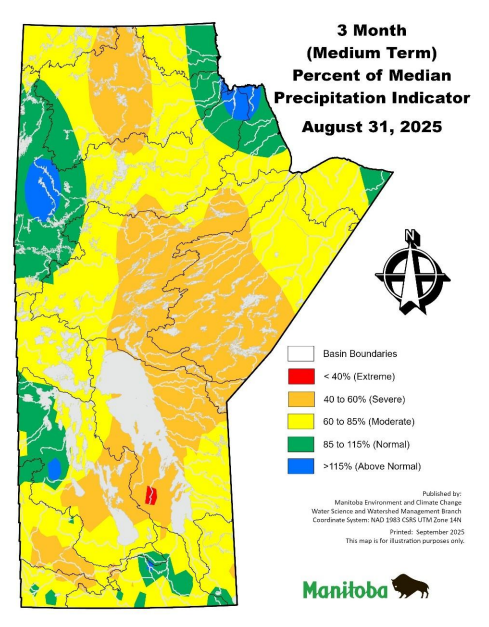 In 2025, the climate did not cooperate with Manitoba. The wildfires that erupted throughout central and northern Manitoba caused irreparable damage to many communities (predominantly Indigenous) and impacted small businesses in the tourism industry, which typically booms in the spring and summer. The wildfires were fueled by drought that lasted until August, and these extreme climate events will spill over into the agriculture and utilities industries. The second consecutive year of below-normal rainfall added pressure to these industries that were still recovering from the previous season.
Manitoba Hydro reported a net loss of $157 million in the 2023-24 fiscal year due mainly to the lower water levels in the Lake Winnipeg water basin. In the 2024-25 fiscal year, they reported a net loss of $63 million, which is an improvement but still undesirable. In the first half of the 2025-26 fiscal year, Manitoba Hydro reported a net loss of $293 million.
Bucking the trend of Manitoba Hydro revenue, agricultural output in Manitoba increased in 2024-25 where crop production rose by 4.3 per cent. However, farmers were under the pressure of the Chinese tariffs on canola, which accounts for more than 12 per cent of total agricultural output and many farmers also struggled with inadequate rain, depending on the region (especially ranchers). With official GDP data for the Manitoba agriculture sector still pending, it remains unclear what the overall growth of the industry will look like.
The trade war, the forest fires and the drought had serious fiscal implications for the government of Manitoba. Total expenditure on the forest fires (containment plus evacuation costs) is estimated at $324 million. On top of that, Manitoba Hydro revenue was much lower than expected, and this deprived the provincial government of approximately $684 million of revenue compared to what was projected in the 2025 budget. Previously, the government was projecting a deficit of $794 million but that figure has been revised to $1.66 billion by the end of 2025.

At the municipal level, the City of Winnipeg published its final budget before the municipal elections in 2026. There will be a surplus of $61.6 million, compared to the small deficit of $63.4 million in last year’s budget. The budget includes substantial investments in infrastructure, such as the North End Waste and Water Treatment Plant, library and recreation facilities and money for Winnipeg Transit. The property tax increase came in at 3.5 per cent, which is lower than first proposed to help Winnipeggers deal with the increased cost of living.
 Despite the wildfires, there was a buzz in the city in 2025. Although the Winnipeg Blue Bombers failed to reach the Grey Cup, losing to Montreal in the East Semifinal after a hot-and-cold regular season, Winnipeg hosted the event to great success. In the downtown core, pedestrians were welcomed back to the Portage and Main intersection for the first time since 1979. Not far from the windiest corner in Canada, two of the city’s landmarks are under reconstruction. The former Hudson Bay Company building is being renovated by the Southern Chiefs’ Organization (SCO), the costs of which are projected to be $310 million. Across the street, the reconstruction of Portage Place has begun, where True North Real Estate Development has partnered with the SCO, federal, provincial and municipal governments. The project will cost between $650 million to $700 million and will contribute housing to the downtown core, a healthcare facility and ample space for other complementary businesses. Last, but not least, the population of the Winnipeg economic region officially exceeded 850,000 by the end of 2025. The one-million-people milestone for the metro area is within sight.
Stringing it all together
The Bank of Canada estimates that the effective tariff rate—which is the average tariff rate paid on all imports—on Canadian products imported by the U.S. increased from 0.1 per cent in 2024 to 4.4 per cent in July of 2025 to 5.9 per cent in October. Tariffs on auto parts, vehicles, and metals explain the majority of that increase. According to RBC Economics, more than 80 per cent of tariffs collected by the U.S. on Canadian goods came from those products. To approximate how the trade wars and drought affected Manitoba’s GDP, we can analyze trade data from Statistics Canada, GDP shares by industry for 2024 (most recent data available) and labour force statistics.
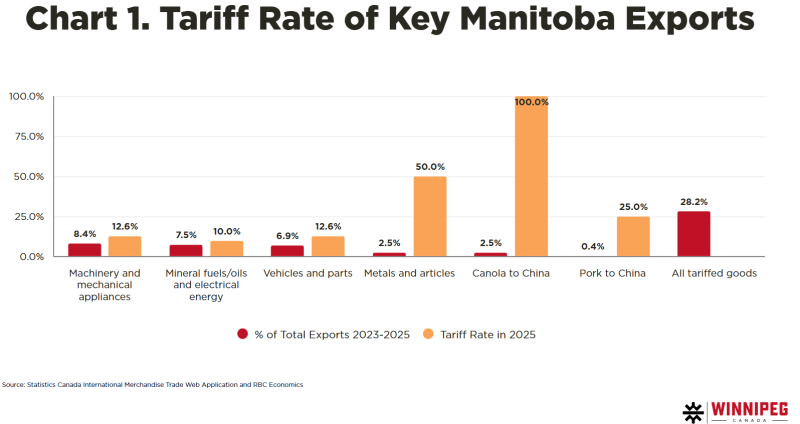
Chart 1 shows which of Manitoba’s exports are subject to tariffs, and their respective shares of total exports between 2023-25. Machinery and mechanical appliances is a vast export category that includes a few products which are used in the production of vehicles. It is subject to the same tariff rate as vehicles and parts, which is set at 25 per cent but effectively 12.6 per cent after the CUSMA compliant components are accounted for. Metals and articles includes all of the aluminum, iron, and steel products that are subject to the 50 per cent tariff. On average, all the tariffed goods accounted for 28.2 per cent of exports between 2023-25.
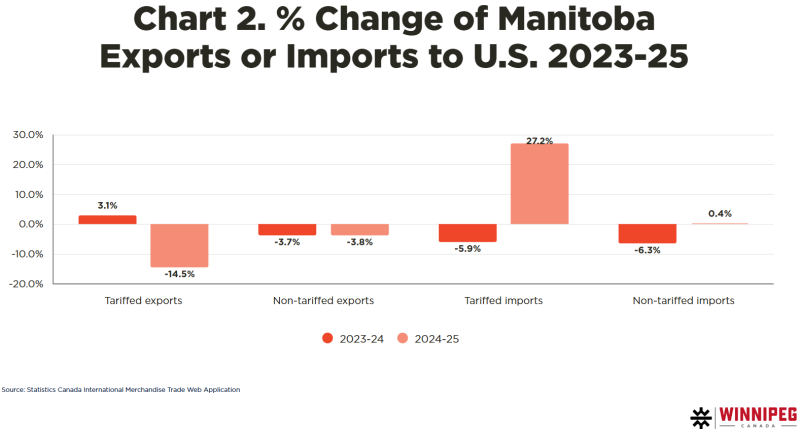
Chart 2 illustrates how Manitoba’s trade with the U.S. changed between 2023-24 and 2024-25. The decline in exports was much larger for tariffed goods than non-tariffed goods (excluding pharmaceuticals, an outlier), which is exactly what was expected to happen. Though, nearly 30 per cent of the decline in tariffed exports is the result of the drought reducing Manitoba Hydro’s output of electrical energy and not the tariffs. The decline in non-tariffed exports was significant, and a part of that can be attributed to these goods complementing, directly or indirectly, the tariffed products. That is to say, the non-tariffed goods are used in production of the tariffed goods or vice versa; or the non-tariffed goods depend on the economic activity created by the production and distribution of the tariffed goods. The drastic rise in imports of U.S. tariffed goods is due to a large increase in light oil (an anomaly) and electrical energy (to fill the gap from the drought) imports. Non-tariffed imports increased by 0.4 percent between 2024-25, which will increase Manitoba’s trade deficit with the U.S. in 2025 and lower GDP.
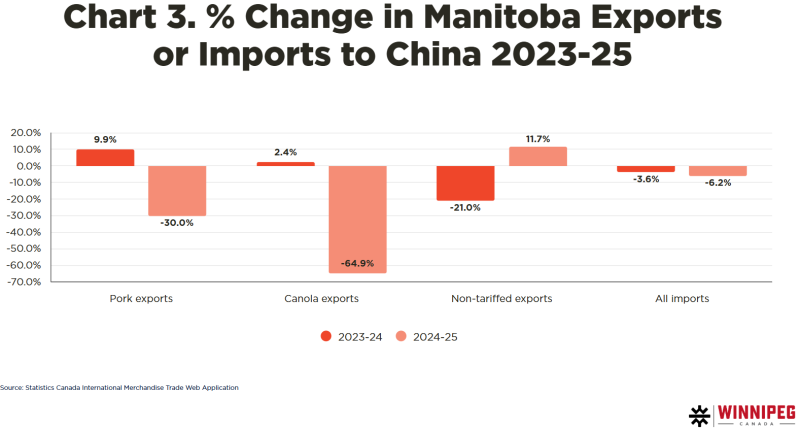
Turning to China in Chart 3, Manitoba does not import pork or canola from China, therefore we are now just presenting exports of these goods. The decline in exports of tariffed products was massive and much larger than the U.S. goods—which is in line with the higher tariff rates. Non-tariffed exports increased in 2025. The Chinese tariffs on Canadian goods were more targeted than the American tariffs. As a result, their impacts did not spill over into other goods/industries in the supply chain. On net, in 2024 Manitoba had a trade deficit with China and the deficit increased in 2025. The decline in the exports of canola is enough to account for the entire trade deficit with China in 2025, and then some. That increase in the deficit will lower GDP for 2025, however, the tariffs on canola have been lifted and the seeds put into storage can be exported to China in 2026 which will boost GDP for that year.
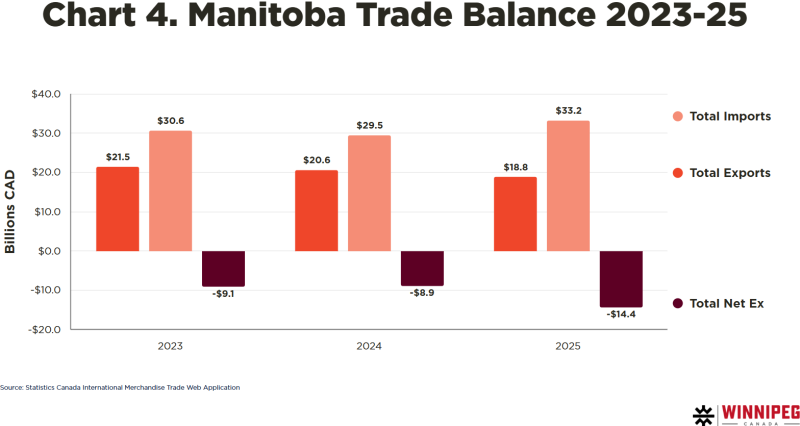
Chart 4 compares all of Manitoba’s exports, imports and net exports (exports minus imports) for 2023, 2024 and 2025. Exports declined by $1.8 billion, while imports increased by $3.7 billion. As a result, net exports declined from -$8.9 billion in 2024 to -$14.4 billion in 2025. All else equal, that trade deficit will lower GDP by $5.5 billion in 2025. In addition to the mechanical decline in GDP, the impact of tariffs will ripple through complex supply chain networks, directly through tariffed goods (outlined above) and then indirectly affecting their source materials, final products, complements and/or substitutes. Domestic purchasers (households, private or public sector) will then feel the knock-on effects of the tariffs after they move through the supply chain. The knock-on effects being lower economic activity from a reduction in business expenditure (investment and/or wages), such as a decline in household consumption.
Industry-level GDP data for Manitoba from 2024 can provide insights into how the trade war and drought will spill over into the rest of the economy. Vehicles, parts, machines and mechanical appliances, and metals are interwoven with manufacturing, transport and storage, and wholesale/resale trade. Together, these industries accounted for 25.7 per cent of GDP in 2024. Agriculture and utilities (Manitoba Hydro)—both impacted by droughts and tariffs—accounted for 4.7 per cent and 3 per cent of GDP in 2024. Utilities were more affected by drought than tariffs (as we saw in the trade data and Manitoba Hydro reports), while agriculture may decline in 2025 due to reduced trade with the U.S. and China; despite the increase in output. In total, 33.4 per cent of Manitoba’s 2024 GDP was directly exposed to tariffs and/or drought. Another factor to consider is that Manitoba trades more interprovincially than internationally, especially with Ontario. As a result, the key industries, outlined above, will feel the pinch (or double pinch) of the decline in economic activity in Ontario and Quebec, adding yet more downward pressure on output.
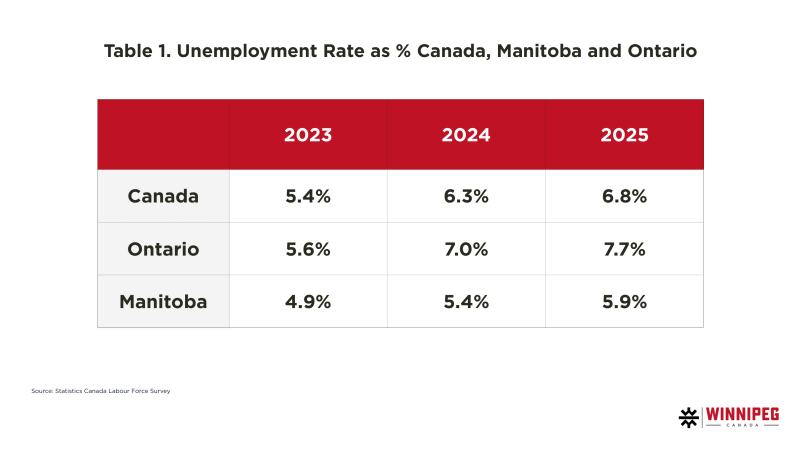 Finally, Manitoba’s labour market performed well in 2025—better than the national average and much better than Ontario. While the unemployment rate rose to 5.9 per cent, it remained well below the national average and almost 2 percentage points lower than Ontario’s. The relative strength of the labour market can partially explain why real GDP forecasts for 2025 were revised upwards from 1.1 per cent in October, 2025 to 1.6 per cent in January, 2026. That revision is a testament to Manitoba’s economic resilience.
The year ahead
It is not an exaggeration to say that the CUSMA review in July could make or break the economy in 2026 and beyond. The agreement could be extended to 2042, renegotiated with varying degrees of revision, abandoned or deferred for review in 2027. The best-case scenario would see an extension or minimal revisions. The worst-case scenario is for the agreement to be abandoned. While postponement may seem neutral, it will only prolong the uncertainty that weighed on the Canadian and Manitoban economies in 2025.
There are, however, glimmers of stability. The Supreme Court of the U.S. struck down the 25 per cent tariffs on non-CUSMA goods, while the tariffs on lumber and metals are still in place. In response to the ruling, 10 per cent tariffs on all imports (non-CUSMA for Canada) were introduced using a different mechanism, but these tariffs have to be renewed by congress after 150 days. Beyond the trade war, slower population growth will temper consumption but ease pressure on housing and public services. Interest rates are expected to remain stable at 2.25 per cent in 2026, barring large movements in inflation, employment, and/or GDP.
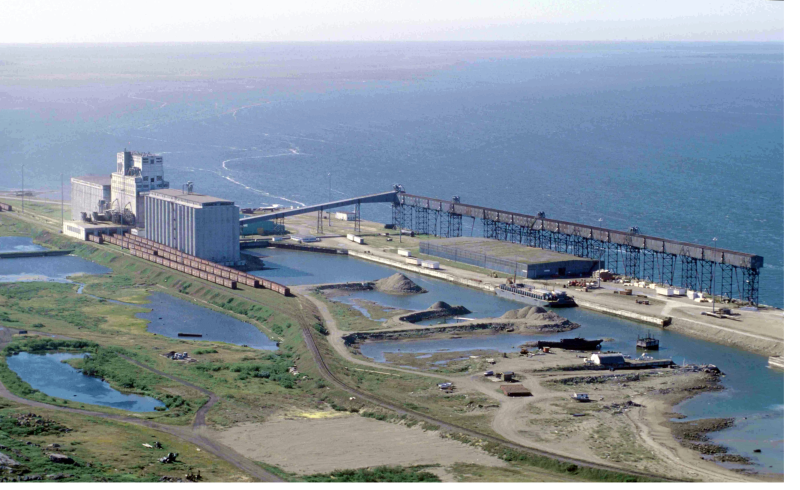 Provincially, eyes are on the 2026 Manitoba budget, which will be written with the federal budget already in hand. Weather will play a key role this year as well, where normal levels of precipitation would help farmers and Manitoba Hydro alike. Progress is also expected on redeveloping the Port of Churchill where a multiparty memorandum of understanding (MOU) was signed in January of 2026. In addition, Manitoba and Winnipeg will receive a boost from the increase in defence spending outlined in the federal budget. In 2023, the Department of National Defence spent $465 million in Manitoba. With defence spending set to double from 1 per cent to 2 per cent of GDP, Manitoba could see over $1 billion in expenditure in 2026.
In Winnipeg, the revitalization of the downtown core will continue, and a new development will be added to the Winnipeg Richardson International Airport (details pending). Overall, the fate of the local economy will depend on the CUSMA review, climate conditions and broader provincial performance. Though 2025 was anything but boring, I think most people would welcome a rather uneventful year in 2026—myself included.
