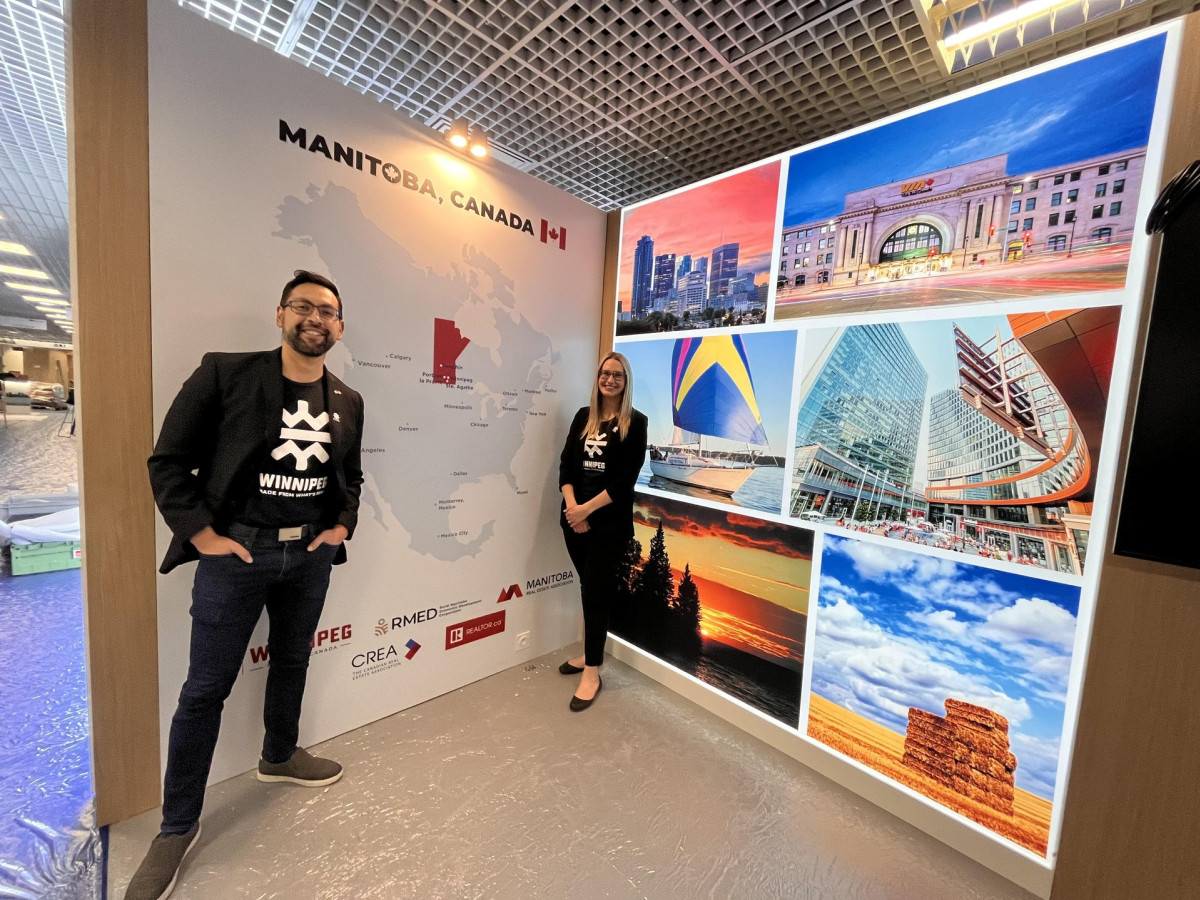
A three-year foreign direct investment (FDI) initiative led by Economic Development Winnipeg (EDW) wrapped in March 2025, marking a major step forward in putting Winnipeg and Manitoba on the global investment map.
Backed by more than $5 million from Prairies Economic Development Canada (PrairiesCan), the Government of Manitoba and EDW, the project focused on raising international awareness, attracting new investment and strengthening ties with foreign-owned businesses. With hundreds of new leads and deeper partnerships now in place, the effort is already reshaping how the world sees this region.
“We’ve gotten the attention of key markets and put Winnipeg and Manitoba on the global investment map,” says Alberto Velasco-Acosta, Vice President of International at EDW. “Now we need to keep that momentum going—and strengthen our position as a top destination for investment.”
Building a strategy and a team
When the FDI team was created in fall 2019, EDW faced a foundational challenge: Winnipeg and Manitoba were barely on the radar in international investment conversations. Under the leadership of Velasco-Acosta, the team adopted a new approach and a shift in mindset. That momentum accelerated with the arrival of Christine Perrin—now Director of FDI—who joined the team in February 2021 and is currently on maternity leave. Perrin played a key role in shaping the team’s strategy. The COVID-19 pandemic, though initially a setback, became a turning point. “It gave us time to sharpen our strategy,” Perrin says. “We identified our target markets and articulated our value proposition to focus where Winnipeg could meaningfully compete.”
That groundwork helped secure federal funding, and by 2022, the project was up and running. With the financial support it needed, EDW’s FDI team grew from a small team of two investment attraction specialists to a market-divided team of 10 focused on North America, Europe, and the Indo-Pacific. Three strategic pillars guide the work:
1. Retain existing foreign-owned business by engaging with their headquarters to ensure satisfaction and identify opportunities to expand their investments and operations in Winnipeg.
2. Attract new investors in target markets and priority economic sectors by building and nurturing a funnel of qualified leads.
3. Show the world what sets Winnipeg and Manitoba apart—our strengths, our advantages and why this is the place to invest and do business.
The region’s value proposition was packaged and promoted internationally, with the team engaging in proactive outreach, travelling to key cities, and relying less on traditional channels. “We wanted to fill the gap, not just react to what came to us,” Perrin says. “It was time to be in the driver’s seat and ramp up proactive investment attraction.”
From hidden gem to trusted partner
The shift from being unknown to becoming a credible player took intention, persistence and relationship-building — and that effort is still ongoing.
“We realized that no one was really talking about Winnipeg and Manitoba,” Velasco-Acosta explains. “The federal government lays the foundation for investment opportunities in Canada, but it’s up to each province to show up and pitch their specific value proposition for foreign investment.”
Ethan Kim, Senior Investment Officer at the Embassy of Canada to the Republic of Korea, in Seoul, echoed Velasco-Acosta’s sentiment. “My role is focused on convincing Korean companies to go to Canada,” Kim said. “In fact, the work that EDW is doing is comparable to the work I started here four years ago, when companies were only meaningfully considering America for FDI.”
Now that Kim has helped put Canada on the map, he’s enthusiastic about the collaborative effort between him and EDW to actively promote Manitoba. “We’re starting to see that companies are thinking of Winnipeg right alongside places like Vancouver and Toronto,” Kim said.
EDW’s team built trust with international investors by being proactive and working closely with local partners like Kim. They took Winnipeg’s story directly to the world—participating in 36 investment missions, trade shows, and events across more than 35 cities in 10 key markets.
Behind the headlines
Pahul Gill, FDI Manager at EDW, knows firsthand the persistence and nuance this work requires, especially in the Indo-Pacific region, where he’s led outreach in key markets including Japan, South Korea, and Singapore.
Rather than relying on trade shows where they encountered language barriers, Gill’s team opted for targeted outreach using research done by EDW’s Market Intelligence team and tools like LinkedIn. “We looked at FDI imports and exports, trade balances and geopolitical factors to find the right matches for Canada—and then Winnipeg and Manitoba,” he says.
In markets like South Korea and Japan, relationships are essential. “It’s not just about selling. You almost become an advisor,” Gill notes. “You build trust with local staff at Canadian embassies and with businesses executives themselves. It takes time, and it’s highly competitive. If you take your foot off the pedal, you disappear.”
Building trust may feel intangible, but Kim helps describe how the effort goes a long way.
“Koreans are known to want answers right away, and we’ve come to count on EDW for super-fast responses,” he said. On top of that, having EDW representatives such as Gill visit Korea regularly helps.
“We’ve established a strong partnership,” said Kim. “We go to meetings and exhibitions together to tell a compelling story about the benefits of investing in Winnipeg and Manitoba.”
While competing for foreign investment with regions all over the world, EDW also explores other tactics to raise awareness and build relationships.
For example, during a gaming conference in San Francisco in March 2025, EDW hosted a business dinner featuring local success stories like Complex Games, who shared firsthand why Winnipeg is a great place to grow. The evening included a trip giveaway—won by a small gaming company from Romania, which recently visited the city.
From these touchpoints, interest has flourished. The lead funnel expanded from just 62 leads in Q1 2022 to more than 300 by the end of Q1 2025 resulting in 33 qualified opportunities. “We’re planting seeds,” says Velasco-Acosta. “They’re not ready to bloom yet, but we’ll keep watering them.”
Leveraging the local ecosystem
No investment story is complete without a compelling offer, and CentrePort Canada is one of Winnipeg’s greatest differentiators. According to Carly Edmundson, President & CEO of CentrePort Canada Inc., this inland port integrates trade, transportation and infrastructure, enabling companies to build and move things better, faster and cheaper.
“We have 20,000 acres of high-quality, affordable industrial land—the size of Manhattan,” says Edmundson. “It includes on-site access to rail, truck and air cargo operations, residential and recreational amenities, and talent pipelines from local institutions like RRC Polytech. It’s an unmatched ecosystem for private sector businesses.”
CentrePort Canada Inc.’s mandate includes attracting investment to the inland port, often targeting companies looking for an ecosystem that helps them expand or streamline their manufacturing and distribution operations.
“As part of our broader efforts to grow Manitoba’s economy, we work closely with organizations like EDW, the City of Winnipeg and the Province of Manitoba to strengthen our roles in business attraction—especially in foreign direct investment,” Edmundson says. “That alignment builds confidence, and it shows in our results.”
This coordinated approach has made CentrePort an invaluable partner in hosting site visits, crafting tailored business packages, and presenting a holistic view of what the region offers— including the quality-of-life perks that matter to executives and their families.
Both Edmundson and Gill recall a recent visit from executives in Asia who initially thought Winnipeg was just “wheat fields.” After experiencing the city and seeing its infrastructure firsthand, their perceptions shifted. They recognized the attractiveness of Winnipeg as a place to operate, not only because they get access to development land and infrastructure, but also the appeal of being near a vibrant urban centre.
“That’s the power of storytelling and firsthand experience,” Gill says.
Lessons learned and the road ahead
The project team is quick to acknowledge that FDI is a long game. Sales cycles span years. Deals can stall with political shifts.
Misconceptions and low awareness of Winnipeg and Manitoba’s unique work and living conditions still exist. But the effort has already delivered one powerful result: Winnipeg is in the conversation.
“Success is that we’re in the room,” says Gill. “That wouldn’t be happening if we hadn’t done this work.” Velasco-Acosta echoed this milestone, adding, “We’re now seen as a partner worth referring.”
The team is now focused on maintaining momentum through strategic follow-ups, carefully chosen trips, and deepening partner engagement.
Key markets remain a priority: the UK, France, and Germany in Europe; Japan, South Korea, and Singapore in the Indo-Pacific; and ongoing engagement across North America. “We’ve built the greenhouse, and our seedlings have taken root,” says Velasco-Acosta. “Now we have to tend the plants.” In a highly competitive landscape, this regular and intentional maintenance is critical to more success.
A blueprint for the future
What this initiative has proven is that a focused, collaborative, and proactive approach works. The ripple effects are just beginning. Perceptions are changing. And a global audience is starting to listen.
When EDW launches its new five-year strategy in November 2025, it’ll be clear how this FDI initiative has shaped and strengthened the organization’s strategic approach. The vision of Winnipeg and Manitoba as globally competitive, welcoming and ready for growth is no longer a dream. It’s becoming a reality, one relationship at a time.
