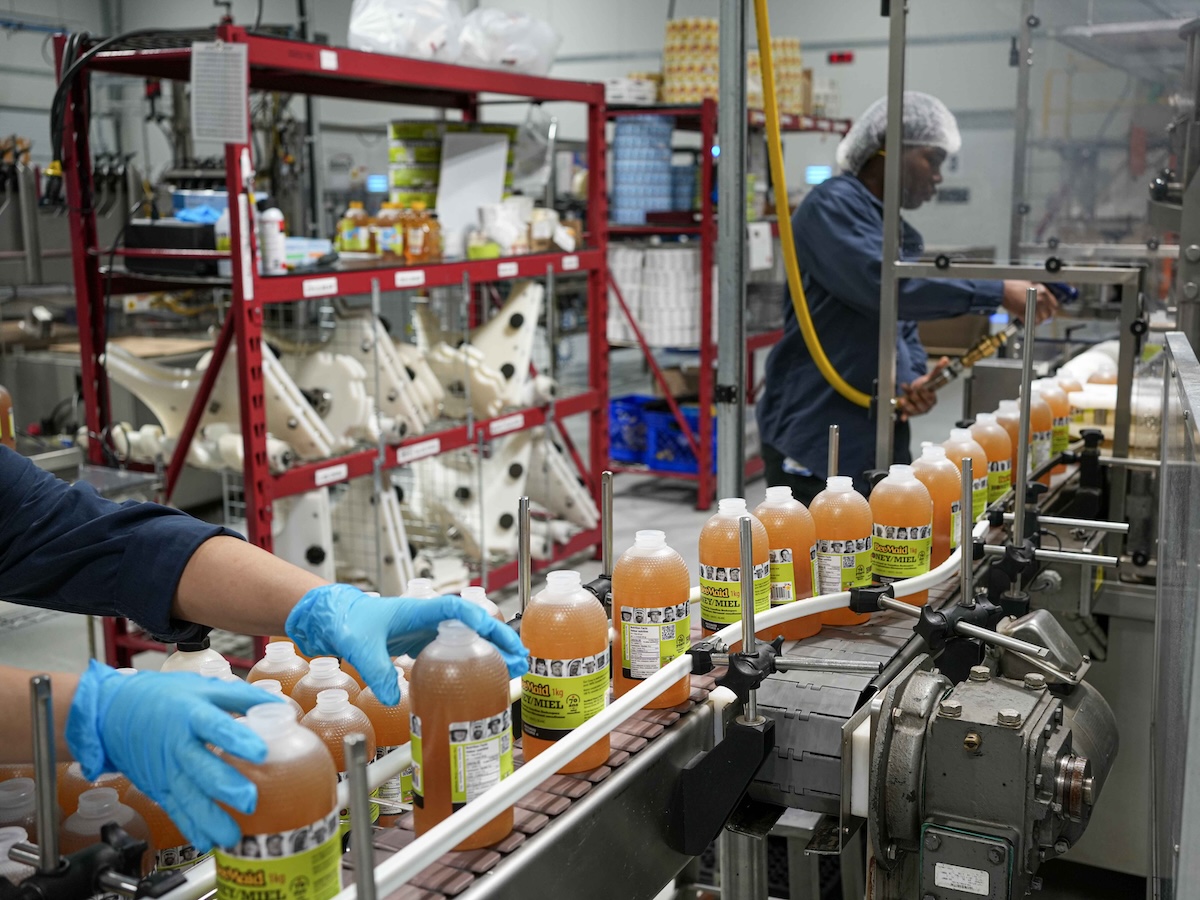
To use the obvious pun, every day it operates, Winnipeg’s BeeMaid Honey facility is abuzz.
The new Winnipeg plant, which started operating in spring 2024 in the equally new Saint-Boniface Industrial Park, replaced BeeMaid's former processing facility in St. James and is almost double its size.
BeeMaid has also recently expanded its processing facility in Spruce Grove, Alberta.
“Total intake for Canadian honey is around 80 to 90 million pounds, so we have a good chunk of that business,” said Henry Klassen, BeeMaid Honey Limited’s COO. “We’re accounting for roughly 30 to 40 per cent of all Canadian honey between the two operations.”
BeeMaid is owned by both the Manitoba Cooperative of Honey Producers and the Alberta Honey Producers Co-operative, with more than 300 members located across the Canadian prairie’s “honey belt.”
These 300-plus members take care of tens of thousands of colonies on their farms, pollinating cash crops that drive the prairie economy while being supported by the BeeMaid headquarters every step of the way.
“In Manitoba, the average membership is 1,200 to 1,500 colonies of bees per farm,” said Kirk Wilson, BeeMaid’s vice president of business growth and membership relations. “In Saskatchewan it’s about 2,500 to 3,500. And, in Alberta it’s about 4,500, with some members that have almost 30,000 colonies.”
Given that your average, healthy mid-summer bee colony in Canada can be up to 80,000 bees, that’s millions of little pollinators on the prairies collecting nectar and turning it into honey that BeeMaid will then turn into the products you’ll find across North American grocery shelves.
BeeMaid Winnipeg employs more than 90 people at the plant, who are doing everything from bottling on the production floor, to logistics, testing, marketing and working its attached store at the $25-million, 129,000-sq. ft facility.
How it’s made
The Winnipeg plant receives 25,000 drums annually that can hold up to 300 kgs of honey from farms across Manitoba and Saskatchewan. Each drum is labeled, identifying the member’s name and number, along with the date it was filled on the farm. The honey is tested in the on-site lab for colour, moisture and residuals before entering the processing stage.
The “buzz” in one section of the plant comes from four massive, 25,000-pound capacity ovens, that slowly turn the solidified honey into something that can be packaged. It’s loud, but it smells incredible.
'“We take our full barrels of honey, drop them in there [the ovens], typically dumped in the afternoon, and by morning, the honey is liquid again,” said Klassen.
“When you think about canola-based honey [the vast majority of BeeMaid’s], it's going to be crystallized,” continued Klassen. “It's pretty much hard as rock… So that's going to take those 12 hours or so to melt down.”
Once the honey is liquified, BeeMaid will then wash those barrels and redistribute them to their members, with the plant currently having a steam cleaner made for them that will cut down on their water usage.
Globally, honey is one of the most adulterated food products. But not here. Everything BeeMaid produces is 100 per cent Canadian and True Source Certified, which verifies that the honey is pure, authentic and ethically sourced.
BeeMaid also produces several premium honeys, including raw honey and clover honey.
“I’m a consumer too,” said Klassen. “And in terms of taste and flavour and that creamy texture, I’ll buy our raw honey every day of the week. You also get a little bit more of that natural good stuff that comes with raw honey.”
New to the lineup is their chipotle hot honey, developed in partnership with RRC Polytechnic's Prairie Research Kitchen.
That said, the majority of the honey packaged at BeeMaid is of the liquid variety.
And those adorable bear bottles you can buy this honey in? BeeMaid produces those too, along with containers for numerous labels and brands across North America that use their honey. Currently, the plant produces about 100 SKUs.
BeeMaid also goes big, as they supply vast amounts of honey for commercial use — for companies that use BeeMaid to sweeten their products.
“We manufacture probably around 80 to 90 per cent of all the bottles we use in various different formats, including the little bears and the big bears,” said Klassen. “And we’ll also fill everything from a 7-kg all the way up to a 1,300-kg tote.”
Your one-stop bee shop
And BeeMaid doesn’t just produce and package honey.
At this massive facility you can do everything from buy honey directly – including numerous sizes, flavours and formats, to purchasing queen bees and all the equipment you need to start your own apiary.
“This really is a one-stop shop for everything you need to run your operation,” said Wilson. “We sell everything from the frames and the wooden boxes to foundations… while we even have pollen right now that's going out to our members.”
Beekeepers who are BeeMaid members can also rely on the company to help them out in spring, when operating costs for beekeepers are at their highest.
“They can buy things here and have a line of credit against their honey… which allows them to keep cash in their pocket [because] the most expensive time for our membership is during spring,” said Wilson, citing how large beekeeping operations will fly in labour and buy packages of bees and queens to replace winter loss.
Our favourite part of the facility tour was meeting the new queen bees that were about to be picked up by farms the following day. As Kirk Wilson explains, a lot can go into picking your queen.
“We work with different queen lines to control mites and [colony] temperatures, and they do have different temperaments. Beekeepers have their favourite types of queens, and we try to have a variety for them to choose from,” said Wilson.
They also told us about queens that run hot, and queens that are chill, but you’ll have to go to BeeMaid’s store to learn that one for yourself.
BeeMaid Honey Limited Winnipeg is located at 645 Black Diamond Boulevard. You can learn more about their products, operation and careers at www.beemaid.com.
