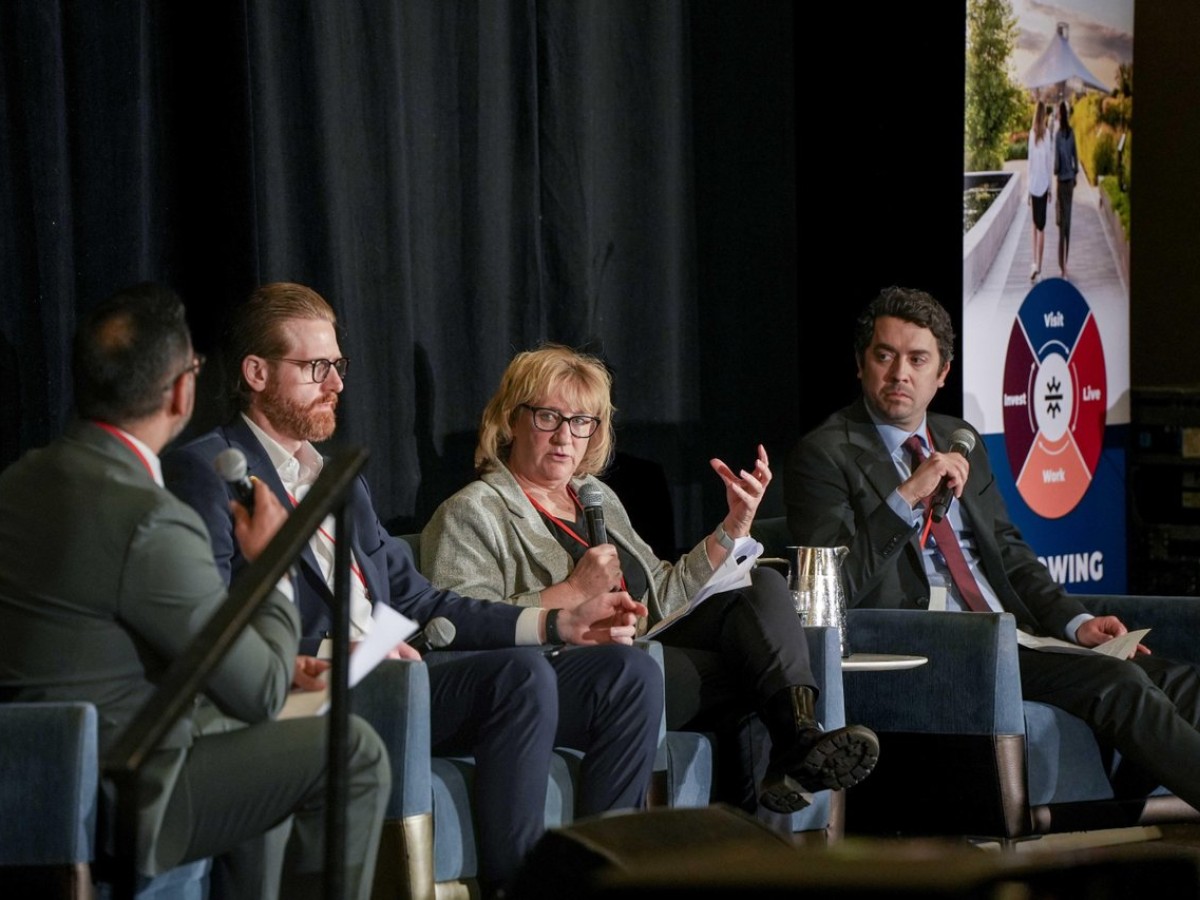
Winnipeg Economic Development & Tourism (Winnipeg EDT) brought together economic development leaders from across Canada last week to talk attracting investment, strengthening competitiveness and navigating today’s rapidly changing economic landscape.
Hosted as part of Winnipeg EDT’s annual Partner Breakfast and presented by Winnipeg Airports Authority, the event featured representatives from Québec International, City of Hamilton and Calgary Economic Development.
Amanda Macdonald, Vice President of Business Development & Market Intelligence at Winnipeg EDT, opened the morning with a look at where Winnipeg stands today and the work underway to strengthen the city’s competitiveness. She shared progress on key initiatives within Winnipeg EDT’s strategy, along with insights gathered through 2025 business retention and expansion interviews.
Macdonald shared data showing just how competitive the race for investment has become across Canada. While provinces such as Ontario, Alberta and British Columbia continue to attract a significant share of investment projects, both Winnipeg and Manitoba have an opportunity to build on our strengths and increase visibility in key global markets.
While Macdonald highlighted strong foundations and growing optimism across the local business community, she also acknowledged there is still work to do to strengthen Winnipeg’s investment readiness.
Alberto Velasco-Acosta, Vice President, International at Winnipeg EDT, spoke about the importance of taking a Team Canada approach to economic development and emphasized the value of building and maintaining strong international relationships.
He also pointed to the growing number of international offices provinces have established to drive investment attraction efforts and strengthen connections in key markets. The reopening of Manitoba’s international office in Washington, D.C. in 2025 was highlighted as an important step in expanding the province’s global presence. Since the Partner Breakfast, the Province has also announced plans to open a new trade office in India, further strengthening Manitoba's international reach and economic ties in a key growth market.
Velasco-Acosta then welcomed the morning’s panelists to the stage:
- Christopher M. Brown, P.Eng, MSc., Vice President, Business Development, Calgary Economic Development
- Jennifer Patterson, Ec. D., CEcD, Manager, Business Investment & Sector Development, Planning and Economic Development Department, City of Hamilton
- François Robitaille, CPA, Managing Director, Foreign Direct Investment, Québec International
During the discussion, panelists shared how their regions are responding to economic uncertainty while continuing to compete for investment and talent.
Recent geopolitical challenges have shifted how economic development agencies are supporting local businesses while continuing to pursue new opportunities. Patterson shared that Hamilton has increasingly prioritized business retention efforts to help companies navigate ongoing challenges in the steel sector.
“Supporting our companies is really key for us. [We’re] helping them understand what new markets they could be focused on for further investment and how we can support them as they tout their supply chains,” she said.
The panelists also discussed the importance of moving quickly while remaining patient, noting that meaningful economic transformation takes time. Cities need to differentiate themselves and stay prepared so they can capitalize when opportunities emerge.
"When [sector] diversification started in 2018, we started going to Silicon Valley... and we were getting criticized for it. Fast forward to today, we're the fastest growing tech talent market for two years in a row. That's an eight-year journey to get to where we are. It takes time and patience," said Brown.
Robitaille spoke about how shifting global conditions have created opportunities to attract talent back to Canada.
“Over the years, we’ve lost a lot of talent [to the U.S.]. We saw an opportunity to reach out to the researchers from Québec who are now abroad and let them know there is funding and opportunities for them to come home,” said Robitaille.
Collaboration was another recurring theme, with panelists emphasizing the importance of strong partnerships between economic development organizations, government and industry.
Brown pointed to Calgary’s recent $120-million capital investment agreement with Lufthansa Technik as an example of what strong partnerships can accomplish.
“At the end of the day, Calgary competed against a $50 million upfront incentive. So it really took relationships, a full-court press and an open-arm mentality to land that.”
The discussion also explored how cities across Canada are working together to compete globally while supporting one another through initiatives such as the Consider Canada City Alliance, a national partnership that brings together Canada’s largest cities to collectively promote Canada in market.
Throughout the discussion, panelists returned to three common themes for cities looking to compete for investment:
- Know your strengths
- Be ready to act quickly
- Build strong partnerships
Together, those themes reinforced a shared message: cities that are collaborative, investment ready and able to respond quickly will be best positioned to compete for future growth opportunities.
**
Quotes have been edited for length and clarity.
